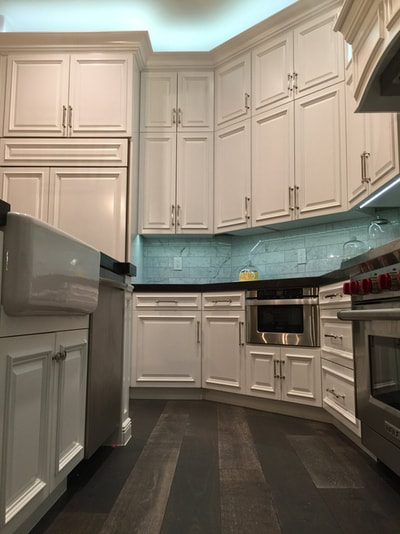
Vanities, linen towers, and integrated medicine cabinets built in our Gilbert shop — finished to withstand a room that gets wet every morning.
A bathroom punishes cabinetry. Daily humidity, splashing, cleaning solvents, hard-water mineral spray off a faucet — the finish system has to do most of the long-term work, and the substrate underneath has to be chosen for that environment from the start.
We build the full bath casework package in our Gilbert shop: floating and furniture-style vanities, full-height linen towers, integrated medicine cabinets that sit flush with adjoining tile, tub aprons, water-closet niches, and matched wall paneling for wainscot or full-height accent walls. Everything leaves the shop pre-finished, so the on-site phase is clean install, not spray and sand.
Substrate decisions are made per project. For high-moisture areas we use Gizir thermofoil and high-pressure laminate fronts that resist swelling at the bottom rail; for painted work we use a Sherwin-Williams catalyzed finish system; for veneered work we draw from the Querkus and Decospan ranges, sealed top and bottom. Edges and end panels get the same treatment as faces — the failures we see on field-replacement jobs almost always start where someone skipped the back side.
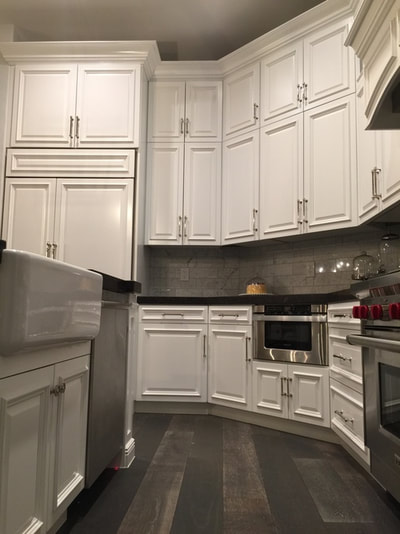
Bathroom cabinetry doesn't usually fail from abuse. It fails from finish breakdown — at the kick, at the toe, at the inside edge of a sink cutout where water sits for ninety seconds at a time.
Our spec for bath work runs to the surfaces nobody photographs. Sink cutouts are sealed with the same catalyzed top-coat used on the faces. End panels and cabinet bottoms carry the same finish schedule front and back. Drawer interiors are sealed against the cleaning sprays that eventually find their way inside. Toe-kicks are dimensioned for the tile thickness the GC actually plans to install, not a generic baseline.
For color, we work off Sherwin-Williams chips on the substrate the cabinet will actually use — paint reads differently on MDF, on a wood-grain veneer, and on Gizir. The sample you approve is the surface you receive.
We measure after demo, not before. We coordinate with the plumber on rough-in locations, with the tile setter on finished-floor height, and with the electrician on outlet and sconce placement so the cabinetry doesn't fight any of them.
Every bath job goes through our CAD shop-drawing process before a saw runs. You see the vanity face, the linen tower elevation, the medicine-cabinet recess, and the wall-paneling layout in elevation and plan view. Approval is in writing.
Before production, you sign off on a finished sample on the actual substrate: Sherwin-Williams paint on MDF, Gizir thermofoil, or a Querkus / Decospan veneer panel. No surprises from chip to install.
The full bath package is built and finished in our Monterey Street shop. Faces, end panels, drawer interiors, and cutouts are sealed before anything ships. The trades on site don't have to work around a spray booth.
We install around the plumber and tile setter, not in front of them. Toe-kicks are scribed to finished tile. Top connections are dry-fit before the stone fabricator templates. Final hardware is set after everyone else clears.
We open every door, run every drawer, and check every reveal with you. Anything that doesn't sit right comes back to the shop — bath work has too little tolerance to leave a "we'll get it next time" on the list.
Either approach works. If your stone top is in good condition and the new vanity footprint matches, we can build to the existing slab — we'll template off it and confirm the sink and faucet cutouts. More often, owners replace the cabinetry and the top together so the proportions and the sink style match the new design.
We coordinate directly with the trades on most residential bath jobs. We measure after demo so plumbing rough-ins are visible, set our finished cabinet heights to the tile setter's finished-floor dimension, and time our install so the stone fabricator can template the day cabinets are set.
For painted work we use a Sherwin-Williams catalyzed finish system on a sealed substrate. For thermofoil and laminate fronts we draw from the Gizir range. For wood-look or real veneer, we use Querkus and Decospan panels with the same top-coat schedule front and back. The substrate and the finish are chosen together — the finish doesn't fix a substrate that wasn't built for moisture.
Yes — recessed medicine cabinets that sit flush with the surrounding tile or wall paneling are one of the things we build most often for bath work. We coordinate the rough opening with the framer or drywaller before the wall closes up, and we build the cabinet box to land cleanly against the finished surface.
Both. A lot of our bath projects include wainscot, full-height accent paneling, tub aprons, or a built-in linen tower in addition to the vanity. Building it all in one shop keeps the finish, profiles, and reveals consistent across the room.
Lead times depend on the scope and the materials, but most bath packages run several weeks from approved CAD drawings to install — material lead time on specialty veneers is usually the long pole. We'll quote a real date range after the on-site measure.
Request a consultation with Frank and the team. We'll measure, coordinate with your trades, and put a real bath cabinet package in your hands before production starts.
Full kitchen cabinetry built in-shop — face frames, inset doors, integrated appliance panels, and the same finish schedule we use on bath work.
Explore → 02Freestanding pieces — dressers, vanities, console cabinets — built to the same shop standards as our built-ins.
Explore → 03For existing bath cabinetry that's structurally sound, we can refinish in-place with a Sherwin-Williams catalyzed system rather than replace.
Explore →